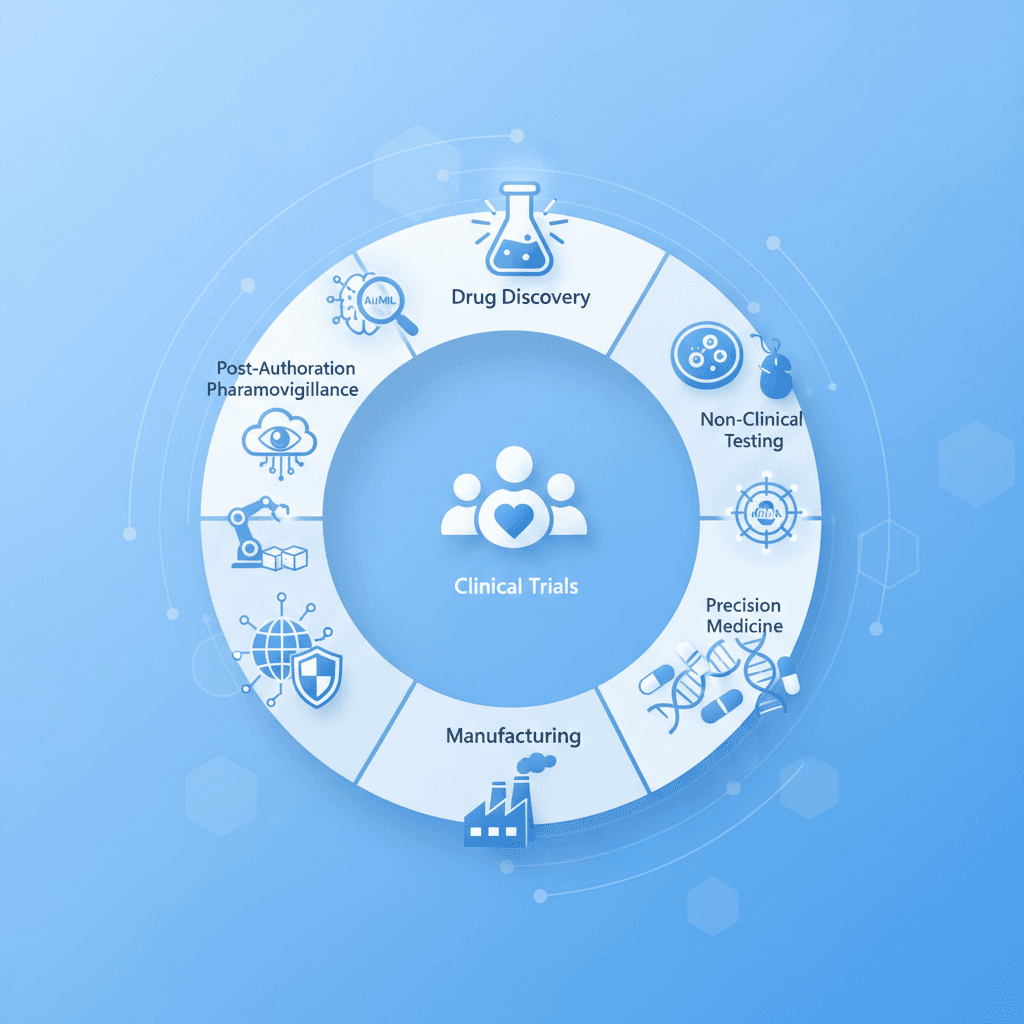
The following sections reflect how AI/ML may be used across the lifecycle of medicinal products, from drug discovery and development to post-authorisation settings such as pharmacovigilance and effectiveness studies.
Drug discovery
AI in drug discovery may be a low regulatory risk setting, as non-optimal performance often mainly affects the sponsor. However, if results contribute to the total body of evidence for regulatory review, principles for non-clinical development should be followed. All models and datasets would normally be reviewed by the sponsor to mitigate ethical issues, risks of bias, and discrimination of non-majority genotypes and phenotypes.
Non-clinical development
AI/ML in non-clinical development may improve data analysis performance and potentially replace, reduce, or refine animal use. Standard Operating Procedures (SOPs) should extend to all AI/ML applications in preclinical studies. When OECD Good Laboratory Practice (GLP) applies, advisory documents on computerised systems and GLP data integrity should be considered. Preclinical data potentially relevant to benefit-risk should be analysed according to a pre-specified analysis plan before any data mining.
Clinical trials
All ICH E6 good clinical practice (GCP) requirements apply to AI/ML in clinical trials. If a model is generated for trial purposes, the full model architecture, modelling logs, validation and testing records, training data, and data processing pipeline description would likely be considered part of the clinical trial data or protocol dossier.
Pivotal trials
In late-stage pivotal trials, risks of overfitting and data leakage must be carefully mitigated. Performance should be tested with prospectively generated data representative of the intended context of use. Incremental learning is not accepted, and any model modification during the trial requires regulatory interaction to amend the statistical analysis plan. Before opening datasets for hypothesis testing, data pre-processing pipelines and models should be locked and documented in the statistical analysis plan.
Precision medicine
AI/ML can individualise treatment based on disease characteristics, genotype, biomarker panels, and clinical parameters — including patient selection and dosing. If referenced in the Summary of Product Characteristics, this is regarded as high-risk from a medicines regulation perspective. Special care is needed in defining what constitutes a posology change requiring regulatory evaluation, providing prescriber guidance, and including fallback treatment strategies for technical failure.
Product information, manufacturing, and post-authorisation
AI used for drafting, compiling, translating, or reviewing product information documents should operate under close human supervision. Generative language models are prone to plausible but erroneous output; quality review must ensure factual and syntactic correctness before regulatory submission.
AI/ML in manufacturing (process design, in-process control, batch release) should follow quality risk management principles considering patient safety, data integrity, and product quality. ICH Q8, Q9, and Q10 principles should be considered for human medicines.
In post-authorisation activities — including pharmacovigilance signal detection — incremental learning may be more flexible, but the marketing authorisation holder remains responsible for validating, monitoring, and documenting model performance within the pharmacovigilance system.