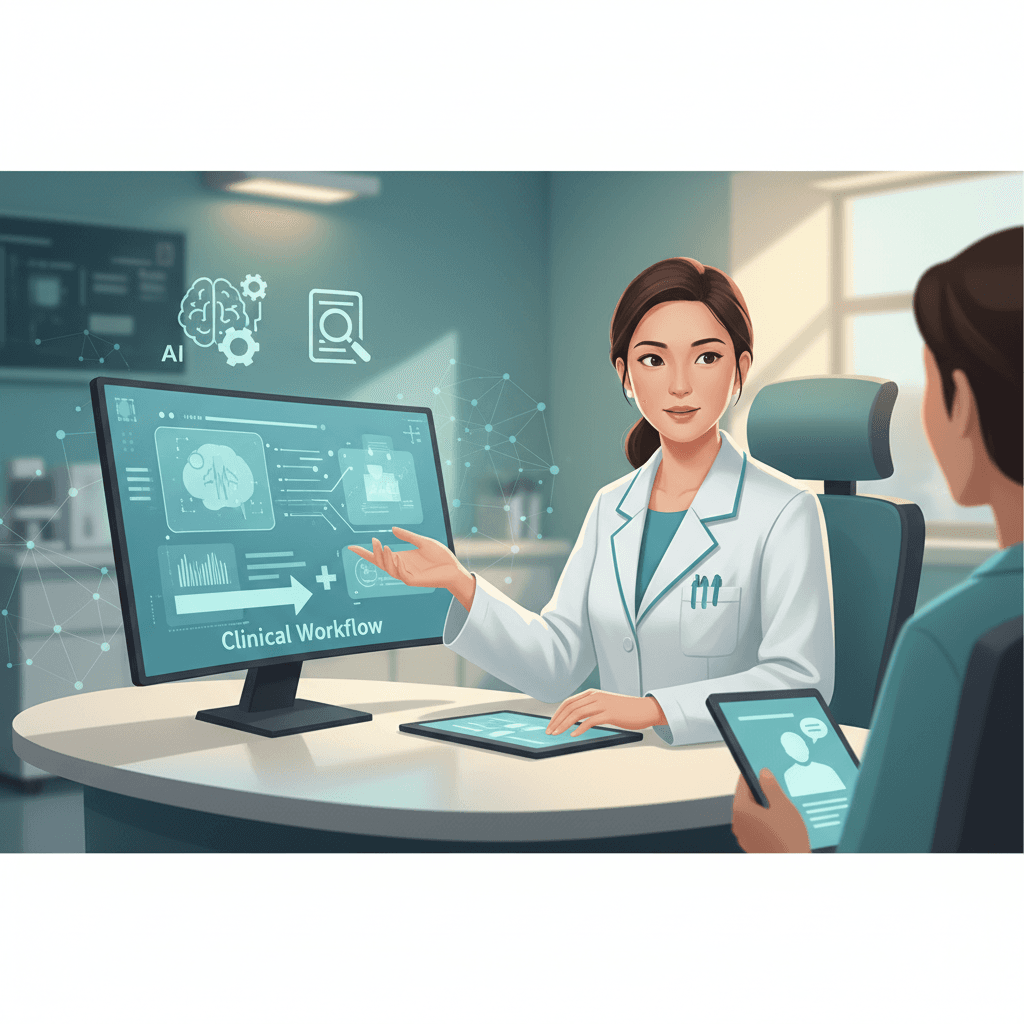
WHO identifies five major clinical use areas for LMMs: diagnosis and clinical care, patient-centred applications, clerical and administrative tasks, medical and nursing education, and research and drug development. This article focuses on the first three — where Hong Kong clinicians encounter LMMs most directly today.
Diagnosis and clinical care
LMMs may assist with complex cases, routine diagnosis review, summarising records, drafting replies to patient messages ("keyboard liberation"), and differential diagnosis support. Pilot programmes already use general-purpose models to draft clinician responses — often requiring heavy editing.
WHO stresses that passing a written medical exam is not equivalent to safe clinical practice. Major risks include:
- Hallucinations — plausible but false responses or invented references; studies report hallucination rates from about 3% to 27% even for simple summarisation tasks
- Data quality and bias — training on internet or skewed health data; contextual bias when recommendations suit high-income settings but not local practice
- Automation bias — clinicians overlooking errors they would otherwise catch
- Skills degradation — over-reliance eroding competence when systems fail
- Informed consent — patients may not know AI assisted or generated communication
Patient-centred applications
Patients and caregivers may use LMM chatbots for health information, virtual assistants, mental health support, or trial matching. Risks include false medical statements, manipulation (persuasive dialogue patterns), privacy breaches when sensitive data is entered into commercial models, reduced clinician–patient contact, epistemic injustice when patient experiences are not recognised, and care delivered outside regulated health systems.
Special populations need extra caution: WHO's expert contributors highlight children (limited evidence on mental/physical well-being) and people with disabilities (historical exclusion from training data leading to discriminatory outputs).
Clerical and administrative tasks
LMMs can translate or simplify language, complete electronic health records, draft visit notes, and support billing documentation — potentially reclaiming hours from documentation burden. However, errors in transcription, translation, or summarisation remain serious; WHO recommends that most clerical functions not be fully automated without human review. Inconsistent outputs from small prompt changes are another known limitation.
For Hong Kong healthcare professionals
- Never enter identifiable patient data into public or unapproved LMM services
- Treat every clinical or patient-facing output as draft requiring your verification
- Document when AI assists care and ensure patients understand its role
- Match the tool to your setting — models trained mainly on US or European data may not reflect local epidemiology, formularies, or pathways