
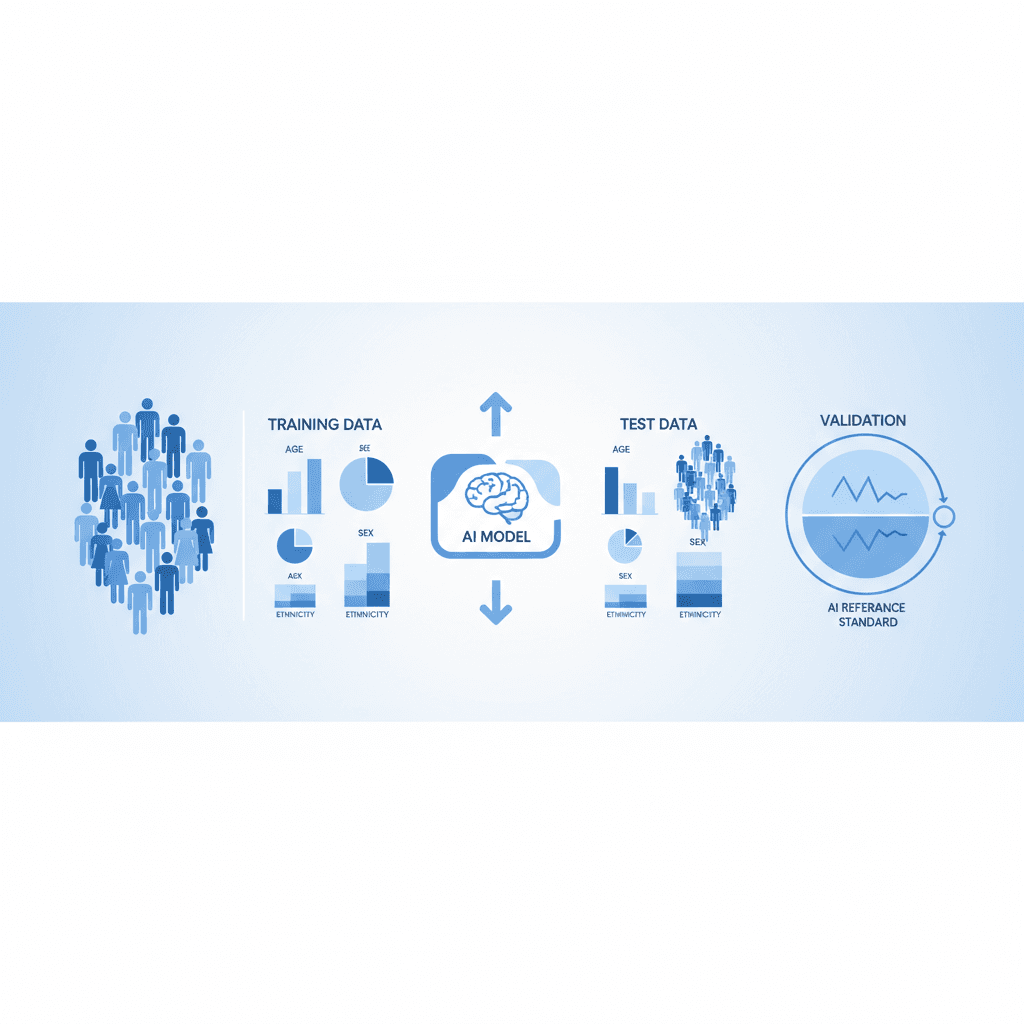
Principle 3: Representative patient populations
Clinical evaluation must use datasets representative of the intended patient population. Data collection protocols should ensure relevant characteristics — such as age, gender, sex, race, ethnicity, geographical location, and medical condition — plus the intended use environment and measurement inputs, are sufficiently represented in samples of adequate size for training, testing, and monitoring.
This is fundamental for clinical evaluation and helps:
- Manage unintended bias and dataset drift
- Promote generalisable performance across the intended population
- Assess usability
- Identify subgroups or circumstances where the model may underperform, including over time
Hong Kong context
An AI model trained predominantly on data from other regions or demographics may underperform for local patients. Ask vendors whether local or comparable Asian populations were included in development and validation.
Principle 4: Independent training and test sets
Training and test datasets must be appropriately independent. All potential sources of dependence — related to patients, sites, and data acquisition — must be considered and addressed.
The extent of external validation should be proportionate to risk. Leakage between training and test data can inflate reported performance and create false confidence in clinical settings.
Principle 5: Fit-for-purpose reference standards
Accepted methods should ensure clinically relevant, well-characterised data are collected and that limitations of reference standards are understood. Documentation should explain:
- Rationale for choosing reference standards based on intended use
- Suitability for the intended use environment
- Use of accepted standards that promote robustness and generalisability, where available
Reference standard selection should reflect broad consensus and appropriate expertise where possible.
Clinical takeaway
When reviewing AI performance reports, check whether the "ground truth" label method matches how you would define the condition in practice — and whether test data were truly independent of training.